Mammography reading services, at a glance
Mammography reading services are outside radiologists who read a facility’s mammograms remotely and send back signed reports. With TeleRads, MQSA-qualified radiologists read your screening and diagnostic mammograms, 2D and 3D, and screening reads are signed in 24 hours or they are free.
- What we readScreening and diagnostic mammograms, 2D digital and 3D tomosynthesis (DBT), and breast ultrasound.
- Who readsMQSA-qualified radiologists, licensed in your state, approved by your medical staff, reading on FDA-cleared (510(k)) mammography displays.
- Screening speed24 hours from when the images reach us, or that read is free.
- ReportsSigned finals in your templates, with a BI-RADS assessment and one of the four MQSA density categories.
- MQSA supportLead Interpreting Physician option, outcomes audit data, reader records kept current.
- SetupWe build the connection (router, VPN, HL7). We set up HL7 and image routing with your IT team and walk them through every step. Credentialing packet on day 1. Tomo archive if you need it.
- PriceOne monthly price, per study or per wRVU. Your price comes in your plan.
- 24 hscreening reads, or that read is free
- 8,702certified US facilities with tomosynthesis units, Nov 1, 2026 (FDA)
- 79%of surveyed breast radiologists say their practice is short of readers (SBI, 2025)
Sources: FDA MQSA National Statistics · Bhole et al., J Breast Imaging 2025. Checked November 20, 2026.
Who it is for
MQSA covers every US mammography facility, fixed or mobile. As of November 1, 2026, FDA counted 9,140 certified facilities, 8,702 of them with tomosynthesis units. The common problem is more studies than readers. In a 2025 Society of Breast Imaging survey, 79% of breast radiologists who answered said their practice is short-staffed for breast radiologists. Demand is rising too: the US Preventive Services Task Force now recommends screening every two years from age 40, not 50.
- Imaging centers with a screening list that grows faster than their readers
- FQHCs and community health centers that run mammography without a breast radiologist on staff
- Rural and critical access hospitals with one general radiologist, or none on site
- Mobile mammography units that screen in many places and need one reading team behind them
- IDTFs (independent diagnostic testing facilities) that need MQSA-qualified readers
- Radiology groups that need overflow on screening days, vacations or a reader’s leave
Sources: FDA MQSA National Statistics · FDA MQSA FAQ (mobile facilities) · Bhole et al., J Breast Imaging 2025 · USPSTF breast cancer screening, April 30, 2024. Checked November 20, 2026.
What we read
| Read | What you get |
|---|---|
| Screening mammography | 2D digital and 3D tomosynthesis. Signed within 24 hours of the images reaching us, or that read is free. |
| Diagnostic mammography | Workups and callbacks, 2D and tomosynthesis. Turnaround set in your agreement. |
| Tomosynthesis (DBT) | Read slice by slice by radiologists with the DBT training MQSA requires. |
| Breast ultrasound | Screening and diagnostic breast ultrasound, reported with the mammogram when they go together. |
| Priors comparison | Your prior mammograms pulled into each read, so a stable finding is not called back as new. |
| Reports | Signed finals in your templates, with a BI-RADS assessment and one of the four MQSA density categories. |
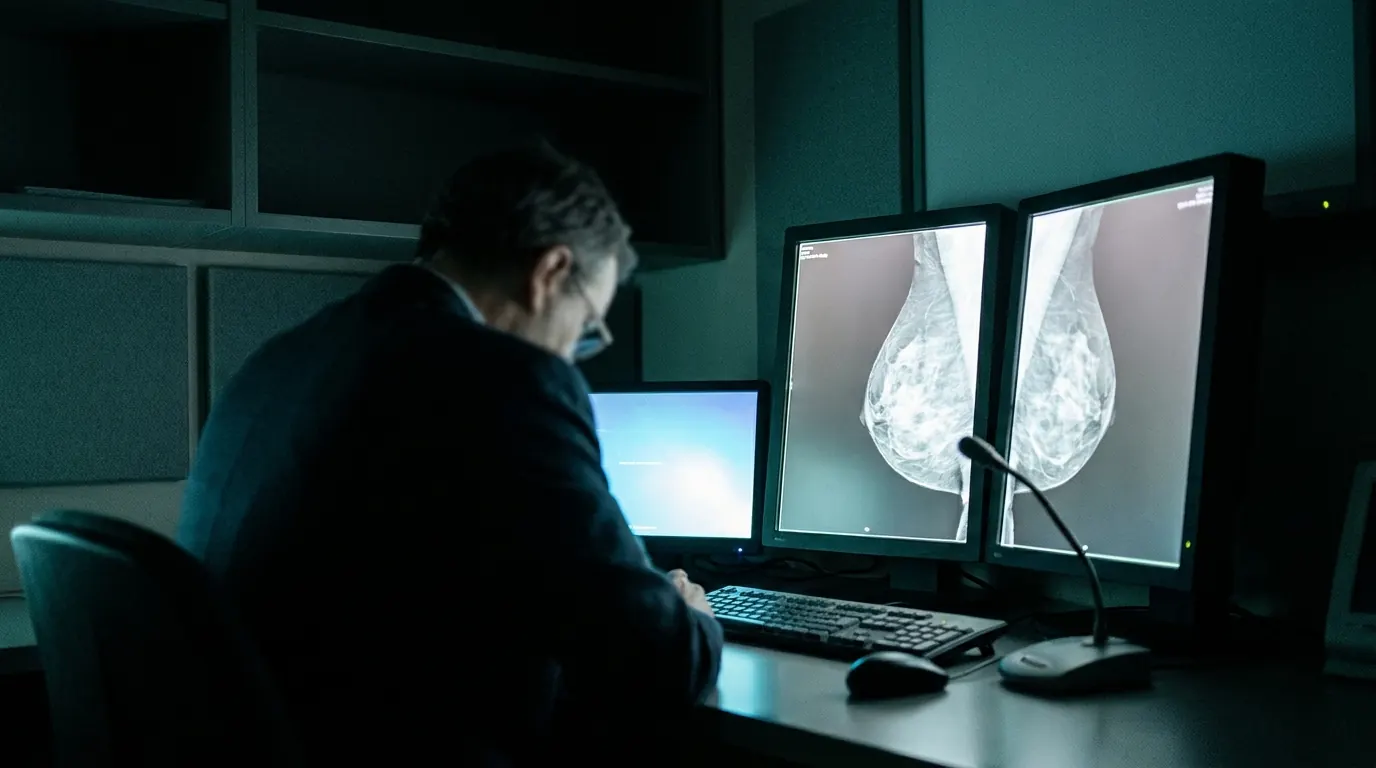
Every report is a signed final, never a preliminary. Read more on preliminary vs final reads.
Screening, diagnostic and recalls
Screening mammography is for women with no symptoms. Medicare pays for one screening exam after at least 11 months have passed since the last one, for women 40 and older. Diagnostic mammography is for a patient with signs or symptoms of breast disease, or a personal history of breast cancer or biopsy-proven benign disease.
| Screening | Diagnostic | |
|---|---|---|
| Who | No symptoms; routine interval | Symptoms, a recall from screening, or a breast cancer history |
| Codes | 77067, plus 77063 for tomo | 77065 or 77066, plus G0279 for tomo (Medicare) |
| Often read | In batches | While the patient is still in the department, at many sites |
| TeleRads turnaround | 24 hours from images in, or free | Set in your agreement |
A recall (callback) is a screening exam assessed “Incomplete: Need additional imaging evaluation.” MQSA uses exactly that assessment to count each reader’s recall rate in the yearly audit. Your facility schedules the diagnostic workup, and we read it when it comes back. If priors are the only thing missing, the reader can assess “Incomplete: Need prior mammograms for comparison,” and a final report must follow within 30 days, whether or not the priors arrive.
Sources: 42 CFR 410.34(a), (d) · 21 CFR 900.12(c), (f) · FDA, MQSA final rule · CMS 2026 PFS RVU file (RVU26D). Checked November 20, 2026.
Reading 3D tomosynthesis
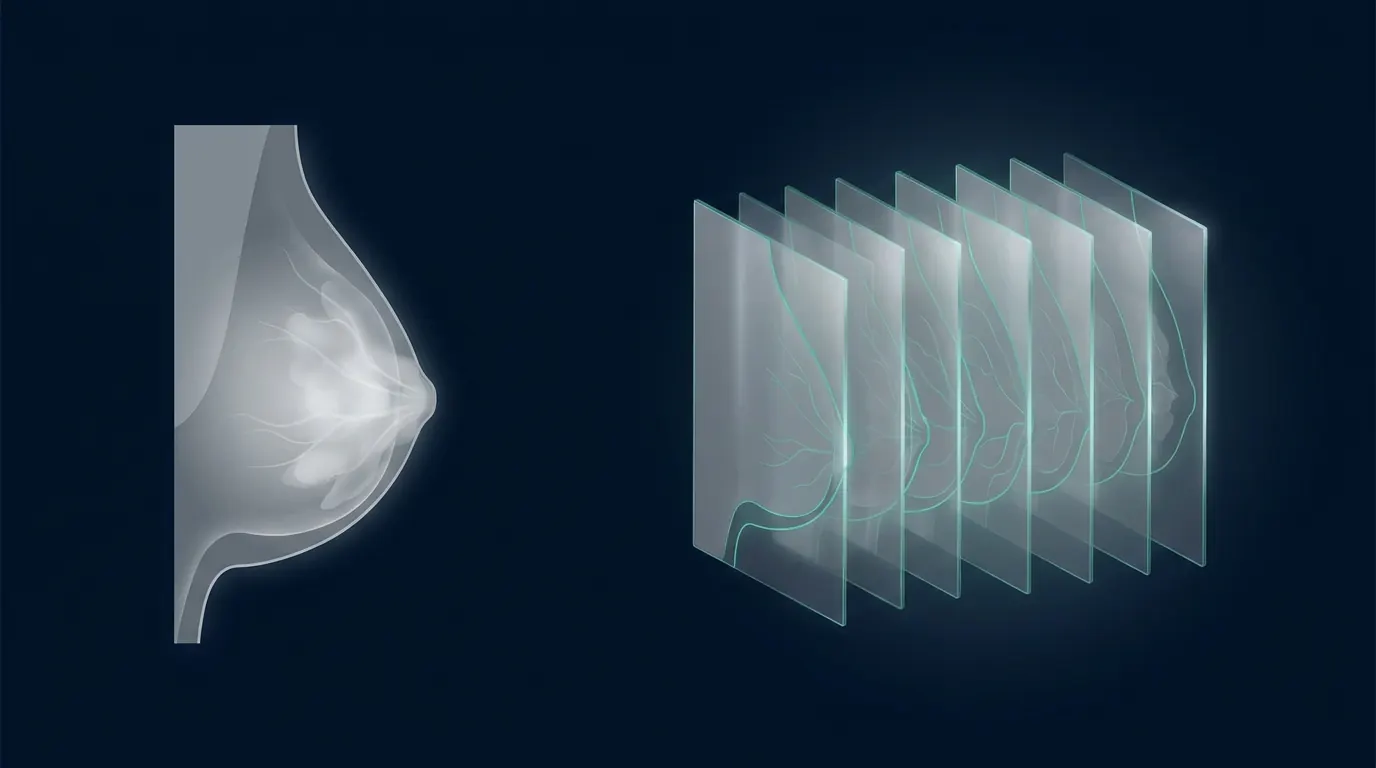
Digital breast tomosynthesis (DBT, “3D mammography” or “tomo”) takes many low-dose images as the X-ray tube moves in an arc, then rebuilds the breast as a stack of thin slices. FDA lists DBT as its own mammographic modality, next to full-field digital mammography.
- 01
Bigger files
Each view is a stack of slices, often 50 to 100. One 2013 estimate put a study at 1 to 1.5 GB before compression. Lossless compression helps, but storage and network still need planning.
- 02
Longer reads
In a 2014 study at Massachusetts General Hospital, 10 radiologists took 2.8 minutes on average for tomosynthesis plus mammography, against 1.9 minutes for 2D alone: 47% longer. The gap shrank with breast imaging experience.
- 03
Priors still matter
A new finding is judged against old images. Priors may be 2D even when today’s exam is 3D, so the reader needs both in the same viewer.
- 04
Training rule
Before reading a new modality such as DBT alone, a radiologist needs at least 8 hours of training in it. Of the 15 CME hours due every 36 months, at least 6 must be in each modality the radiologist reads.
- 05
Keeping originals
MQSA requires original images to be kept at least 5 years, or 10 years if the patient has no later mammogram at your facility, or longer if state law says so.
- 06
Our part
We read 2D and tomo, pull priors into each read, and can archive tomosynthesis studies for you if your storage is filling up.
Sources: 21 CFR 900.2(z) · Clunie, SIIM 2013 · Dang et al., Radiology 2014;270(1):49-56 · 21 CFR 900.12(a)(1)(ii) · FDA, MQSA final rule (records). Checked November 20, 2026.
MQSA reader qualifications
MQSA calls the radiologist an interpreting physician. These are the federal minimums every TeleRads mammography reader meets. Our full guide is MQSA requirements for radiologists.
| Rule | To qualify | To stay qualified |
|---|---|---|
| License | Licensed to practice medicine in a state | Kept current |
| Board or training | Board certified by an FDA-approved body, or 3 months of formal mammography training | Not repeated |
| CME | 60 category I hours in mammography, 15 of them in the last 3 years | 15 category I hours every 36 months, at least 6 in each modality read |
| Experience | 240 exams read under direct supervision in the 6 months before qualifying | 960 exams every 24 months, counted back from your inspection date |
| New modality | At least 8 hours of training before reading it alone (for example DBT) | Applies each time a modality is added |
MQSA asks for a license “in a State.” Which state’s license a remote reader needs comes from state medical board rules. TeleRads readers are licensed in your state. Your facility must keep each reader’s qualification records for the inspector, and keep them at least 24 months after a reader leaves. We supply the full set up front and keep it current as exam counts and CME renew.
Sources: 21 CFR 900.12(a)(1), (a)(4). Checked November 20, 2026.
The 2024 density and reporting rules
FDA amended the MQSA rules on March 10, 2023, and began enforcing them on September 10, 2024. What changed for the report and the patient:
| Category | Required wording in the report |
|---|---|
| A | “The breasts are almost entirely fatty.” |
| B | “There are scattered areas of fibroglandular density.” |
| C | “The breasts are heterogeneously dense, which may obscure small masses.” |
| D | “The breasts are extremely dense, which lowers the sensitivity of mammography.” |
- Lay summary: the patient’s letter must say whether the tissue is dense or not dense, in FDA’s wording. Your facility sends it.
- 7-day clock: Suspicious and Highly Suggestive of Malignancy results reach the referring provider and the patient within 7 calendar days of the final read.
- 30-day clock: all other lay summaries within 30 days of the exam; an “Incomplete: Need prior mammograms” exam gets its final report within 30 days.
- Assessment categories: Negative, Benign, Probably Benign, Suspicious, Highly Suggestive of Malignancy, Known Biopsy-Proven Malignancy, and Post-Procedure Mammogram for Marker Placement.
- Facility details: the report carries your facility’s city, state, ZIP code and phone number.
Our reports carry the assessment and the density category in your template, so your team can drop them straight into the lay summary. Ask us about patient result letter support.
Sources: 21 CFR 900.12(c) · FDA, MQSA final rule · 88 FR 15126. Checked November 20, 2026.
Lead Interpreting Physician
Every MQSA facility must name a Lead Interpreting Physician (LIP). The LIP is the interpreting physician with general responsibility for making sure the facility’s quality assurance program meets FDA’s requirements. What that covers:
- The QA program in 21 CFR 900.12(d) to (f): who does what, and that it is done
- QA assignments: no one else may be given QA duties unless the LIP has judged them qualified
- Quality control with your technologists and medical physicist
- Clinical image quality and corrective action when images fall short
- The outcomes audit: the facility also designates a physician to review it, and one physician can do both jobs
Many small facilities, FQHCs and mobile programs have no breast radiologist on staff to take the role. TeleRads offers a Lead Interpreting Physician option: an MQSA-qualified radiologist who takes the role for your facility, works with your technologists and medical physicist on the QA program, and reviews the audit with you. It is a monthly fee per site, and your price comes in your plan.
Sources: 21 CFR 900.2 (lead interpreting physician) · 21 CFR 900.12(d)(1)(i), (f)(3). Checked November 20, 2026.
Medical outcomes audit
MQSA requires a medical outcomes audit at least once every 12 months. It must report, for each reader and for the facility as a whole:
| Metric | What it measures |
|---|---|
| Positive predictive value | How many positive mammograms led to a cancer diagnosed within 1 year of the exam |
| Cancer detection rate | Cancers found, per 1,000 patients examined |
| Recall rate | Share of screening exams assessed “Incomplete: Need additional imaging evaluation” |
The audit physician reviews the data, tells each reader their own and the facility’s results, and documents any follow-up. We send the reader-level data your audit needs. Your facility supplies the biopsy and pathology results that close the loop. See also radiology peer review.
Sources: 21 CFR 900.12(f) · FDA, MQSA final rule. Checked November 20, 2026.
IT, connection and tomo storage
What your team does
- Gives us a contact for your modalities or PACS
- Approves the connection
- Keeps scanning
What TeleRads does
- Builds the connection: our router, a VPN and HL7 for orders and reports
- Reads on our PACS; we set up HL7 and image routing with your IT team
- Pulls priors into each read
- Archives tomosynthesis studies for you, if you need the space
- Sends signed reports back into your system
MQSA says digital images for final interpretation must be provided electronically, in their original form, not as digitized film. Our technology runs on SOC 2-compliant platforms, and we sign a HIPAA Business Associate Agreement with every facility. More on DICOM routers and DICOM and HL7.
Sources: FDA, MQSA final rule (records and transfers). Checked November 20, 2026.
Credentialing, done for you
We send a complete packet on day 1: license, board certification, MQSA qualification records, CME, DBT training, malpractice and references. If your medical staff office asks for anything else, we chase it, not you. You get one point of contact and a status update every week until every reader is approved. Credentialing and the connection run at the same time. See how teleradiology credentialing works.
Billing and coding
General information for 2026, not billing advice. Payer rules differ. Check codes and modifiers with your billing team or advisor.
| Code | What it is | Work RVU |
|---|---|---|
| 77067 | Screening mammography, bilateral, incl. CAD | 0.74 |
| 77063 | Screening DBT add-on, bilateral | 0.59 |
| 77065 | Diagnostic mammography, unilateral, incl. CAD | 0.79 |
| 77066 | Diagnostic mammography, bilateral, incl. CAD | 0.98 |
| G0279 | Diagnostic DBT add-on (Medicare), unilateral or bilateral | 0.59 |
| 76641 | Breast ultrasound, complete, unilateral | 0.71 |
| 76642 | Breast ultrasound, limited, unilateral | 0.66 |
- Screening 3D: 77067 plus the add-on 77063.
- Diagnostic 3D, Medicare: 77065 or 77066 plus the add-on HCPCS code G0279. CMS lists CPT 77061 and 77062 as not valid for Medicare. Commercial payers may differ.
- Breast ultrasound: 76641 (complete) or 76642 (limited), per breast.
- Global, PC and TC: a global claim covers both parts. Modifier 26 is the professional component (the read). Modifier TC is the technical component (equipment, technologist, facility).
- Who bills the read: either the reading group bills the professional component and your facility bills the technical component, or your facility bills globally and pays the reader. Medicare’s anti-markup rule (42 CFR 414.50) limits what a billing party can collect for a test read outside its practice.
- IDTFs: Medicare’s IDTF rules exempt diagnostic mammography from the IDTF supervising-physician standards, because FDA regulates it under MQSA. Medicare only covers mammography from a facility with a valid FDA certificate.
- FQHCs: CMS lists screening mammography among FQHC services. The technical component of a diagnostic test is billed separately to the Medicare contractor. The professional component is an FQHC service when an FQHC practitioner furnishes it.
Sources: CMS 2026 PFS Relative Value File, RVU26D (updated Aug 26, 2026) · 42 CFR 414.50 · 42 CFR 410.33(a)(2) · 42 CFR 410.34 · CMS Benefit Policy Manual, ch. 13 (Rev. 13600, Feb 20, 2026). Checked November 20, 2026.
What does outsourced mammography reading cost?
There is no public price list for teleradiology mammography. Groups price in a few common ways, and Medicare’s professional payment is a useful public benchmark for what a read is worth.
- Per study: one price per screening or diagnostic exam, sometimes with a different price for tomo
- Per wRVU: a price per work RVU, so a 2D screening read (0.74) and a 3D add-on (0.59) are priced by their weight
- Monthly LIP fee: the Lead Interpreting Physician role, usually priced per site per month
| Code | What it is | PC total RVU | National amount |
|---|---|---|---|
| 77067-26 | Screening mammography, bilateral, incl. CAD | 1.05 | $35.07 |
| 77063-26 | Screening DBT add-on, bilateral | 0.83 | $27.72 |
| 77065-26 | Diagnostic mammography, unilateral, incl. CAD | 1.13 | $37.74 |
| 77066-26 | Diagnostic mammography, bilateral, incl. CAD | 1.39 | $46.43 |
| G0279-26 | Diagnostic DBT add-on (Medicare), unilateral or bilateral | 0.83 | $27.72 |
| 76641-26 | Breast ultrasound, complete, unilateral | 1.01 | $33.73 |
| 76642-26 | Breast ultrasound, limited, unilateral | 0.94 | $31.40 |
Amounts are total professional RVUs times the 2026 conversion factor of $33.4009 for clinicians not in a qualifying APM, national and unadjusted. Local payment changes with the geographic index, sequestration and the patient’s coinsurance. Commercial payers and contracts vary. As an example, a 3D screening read (77067-26 plus 77063-26) comes to about $62.79 nationally.
TeleRads: one monthly price, per study or per wRVU, whichever fits your mix. The LIP option is a monthly fee per site. Your price comes in your plan. See how teleradiology pricing works.
Sources: CMS 2026 PFS Relative Value File, RVU26D, PPRRVU2026_Oct_nonQPP (amounts calculated from the file). Checked November 20, 2026.
In-house reader vs locum vs teleradiology
| In-house breast radiologist | Locum radiologist on site | Teleradiology (TeleRads) | |
|---|---|---|---|
| Getting started | Recruit, hire, license, privilege | Recruit, license, privilege, travel | Credentialing and connection run together; packet on day 1 |
| Cost shape | Salary and benefits | Daily rate plus travel and lodging | One monthly price, per study or per wRVU |
| Vacations and leave | List waits or needs cover | One person, one schedule | Readers added as volume grows |
| Screening turnaround | Depends on staffing | Depends on the locum’s days | 24 hours from images in, or free |
| MQSA records | You maintain them | You collect them for each locum | We supply them and keep them current |
| Lead Interpreting Physician | Can take the role | Hard on short stays | LIP option |
| On-site procedures | Yes | Yes | No: biopsies and procedures stay with on-site staff |
| IT | Your PACS | Your PACS | We build the connection; set up with your IT team |
Many facilities mix them: an on-site radiologist for procedures and diagnostic days, teleradiology for the screening list. See hiring a locums radiologist and daytime overflow.
Checklist before you outsource mammography
Ask any reading group for these, in writing
- Each reader’s MQSA records: 960 exams in 24 months and 15 CME in 36 months, measured against your inspection date
- DBT training (at least 8 hours) for every reader who reads tomo, and 6 CME hours per modality
- A license in your state and privileges from your medical staff, before the first read
- FDA-cleared (510(k)) mammography displays
- Reports in your template with BI-RADS assessment and the four MQSA density categories
- How Suspicious and Highly Suggestive results reach you inside the 7-day window
- How priors reach the reader, and who tracks “Incomplete: Need prior mammograms” exams to the 30-day final
- Reader-level audit data: PPV, cancer detection rate, recall rate
- Who is your Lead Interpreting Physician, and who reviews the audit
- Turnaround in the contract, and what happens when a read is late
- A signed BAA, where images are stored, and who keeps originals for 5 to 10 years
- Who bills the professional component
Our teleradiology contract checklist covers the general terms.
How it works
- 01
A short call
Your volume, screening and diagnostic mix, 2D or tomo, mobile sites, and whether you need a Lead Interpreting Physician.
- 02
Credentialing and connection, together
We send the complete credentialing packet while we build the router, VPN and HL7 link and load your report templates.
- 03
Test reads
Test studies run end to end, with priors, before a live patient is read.
- 04
Live reading
Screening reads signed within 24 hours of the images reaching us, or free. One monthly price, per study or per wRVU.
Questions
What are mammography reading services?
Mammography reading services are outside radiologists who interpret a facility’s mammograms remotely and send back signed reports. TeleRads reads screening and diagnostic mammograms, 2D and 3D tomosynthesis, and breast ultrasound, with MQSA-qualified radiologists who are licensed in your state and approved by your medical staff.
Can a radiologist read our mammograms remotely under MQSA?
Yes. The MQSA rules for interpreting physicians in 21 CFR 900.12 cover qualifications, records and reports. They do not require the reader to be on site. The images must be read in their original digital form, and FDA says a display used to interpret digital mammograms generally needs 510(k) clearance. Your facility keeps its MQSA certificate, its accreditation and each reader’s records.
What MQSA qualifications do your readers have?
Every TeleRads mammography reader meets 21 CFR 900.12(a)(1): a state license, board certification or 3 months of formal mammography training, 60 category I CME hours and 240 supervised exams to qualify, then 960 exams every 24 months and 15 CME hours every 36 months, with at least 6 in each modality they read. Their records come in the credentialing packet and we keep them current.
Do you read 3D mammography (tomosynthesis)?
Yes. We read screening and diagnostic digital breast tomosynthesis (DBT) as well as 2D digital mammography. MQSA requires at least 8 hours of training in a new modality such as DBT before a radiologist reads it alone, and our tomo readers have it.
What does “24 hours or it’s free” mean?
A screening mammogram is read and signed within 24 hours of its images reaching us, or that read is not charged. Diagnostic turnaround is set in your agreement.
What monitors do your radiologists read mammograms on?
FDA-cleared (510(k)) mammography displays. MQSA requires devices used in mammography to have FDA premarket authorization for their use, and FDA says a display used to interpret digital mammograms generally needs 510(k) clearance.
What changed in the 2024 MQSA rule?
Since September 10, 2024, every report states breast density in one of four categories, and the patient’s lay summary says whether the tissue is dense or not dense. Suspicious and Highly Suggestive of Malignancy results must reach the referring provider and the patient within 7 calendar days of the final read. An exam read as Incomplete because priors are needed gets a follow-up report within 30 days. The yearly audit now reports recall rate, cancer detection rate and positive predictive value for each reader.
Who sends the lay letter to the patient?
Your facility. MQSA puts the lay summary on the facility: within 30 days of the exam, or within 7 days of the final read for Suspicious or Highly Suggestive results. Our reports give the assessment and density category your letter needs. Ask us about patient result letter support.
What is a Lead Interpreting Physician, and can you provide one?
Every MQSA facility must name a Lead Interpreting Physician, who has general responsibility for making sure the quality assurance program meets FDA’s requirements. TeleRads offers a Lead Interpreting Physician option for facilities that do not have one on staff, priced as a monthly fee per site in your plan.
Which CPT codes are used for 3D mammography?
Screening tomosynthesis is the add-on code 77063, billed with screening mammography 77067. For Medicare, diagnostic tomosynthesis is the add-on HCPCS code G0279, billed with 77065 or 77066. CPT codes 77061 and 77062 are listed as not valid for Medicare in the 2026 fee schedule file. This is general information, not billing advice.
Who bills for the professional reading?
It depends on your contract and your payers. Either the reading group bills the professional component (modifier 26) and your facility bills the technical component, or your facility bills globally and pays the reader, subject to Medicare’s anti-markup rule. Confirm the setup with your billing advisor.
How much does outsourced mammography reading cost?
Pricing is usually per study or per wRVU, and a Lead Interpreting Physician role is often a monthly fee. As a public benchmark, the 2026 Medicare national professional payment is about $35 for a screening mammogram (77067-26) plus about $28 for the tomosynthesis add-on (77063-26), before local adjustment. TeleRads charges one monthly price, and your price comes in your plan.
How do you handle priors and callbacks?
We pull your prior mammograms into each read. If priors are missing, MQSA lets the reader mark the exam Incomplete: Need prior mammograms for comparison, and a final report must follow within 30 days. A screening exam that needs more views is assessed Incomplete: Need additional imaging evaluation, which is a recall, and your facility schedules the diagnostic workup.
Can FQHCs and mobile mammography units use teleradiology?
Yes. MQSA applies to mobile units the same as fixed sites, and CMS lists screening mammography among FQHC services. We read for one site or many under your MQSA certificate.
Do we have to install anything or store the tomo files?
No. We read on our PACS, and we set up HL7 and image routing with your IT team and walk them through every step. We build the connection with our router, a VPN and HL7. Tomosynthesis studies are large, so if you need somewhere to keep them, we can archive them for you.
Sources: 21 CFR 900.12 · 21 CFR 900.2 · FDA, MQSA final rule · 88 FR 15126 · CMS RVU26D · CMS BPM ch. 13. Checked November 20, 2026.
Talk to us
Tell us what you need read. We will send a free coverage plan with who would read for you, your go-live date and your price.